© Laura Manfredi
April 24 marked the opening of the 2026 season of Innsbrucker Hofmusik, the concert series of early music founded in 2022 from an idea of Franz Gratl, director of the Music Collection of the Tiroler Landesmuseen, and organist and conductor Marian Polin, who is artistic director of the festival. Strengths of Innsbrucker Hofmusik are, of course, the musical program, prepared with loving philological care, and the atmospheric setting in Innsbruck's court church, an artistic and acoustic gem.
I met Marian Polin after the dress rehearsal of Monteverdi's "Selva morale e spirituale," the first concert on the program. With a well-deserved beer in hand, we chatted about Innsbrucker Hofmusik.
TWO TALKS WITH MARIAN POLIN
Hello Marian, you are the artistic director of Innsbrucker Hofmusik, you are an organist and conductor. Can you tell me how your passion for music came about?
I started playing the piano when I was about 10 years old. But my encounter with the organ happened in church: I was an altar boy and I was fascinated by the organ I heard playing during celebrations. Then, one day, they let me try to play it. After the first few bars I was thunderstruck and the organ then became my instrument.
And then?
Then I sang in a choir, I directed a youth choir. The repertoire was varied and went from pop to classical and from classical to early music. After high school I studied sacred music in Vienna-I realized that I was interested in music older than what was commonly studied. Usually you start with Bach and Viennese classical, maybe some pieces by Schütz, Palestrina or Orlando di Lasso. When I studied, you would delve into how to play up to Bach, but how to make music before him, that was a bit of a secret. My great passion is to try to unlock the secret of how to interpret the music of the 1500s and especially the 1600s.
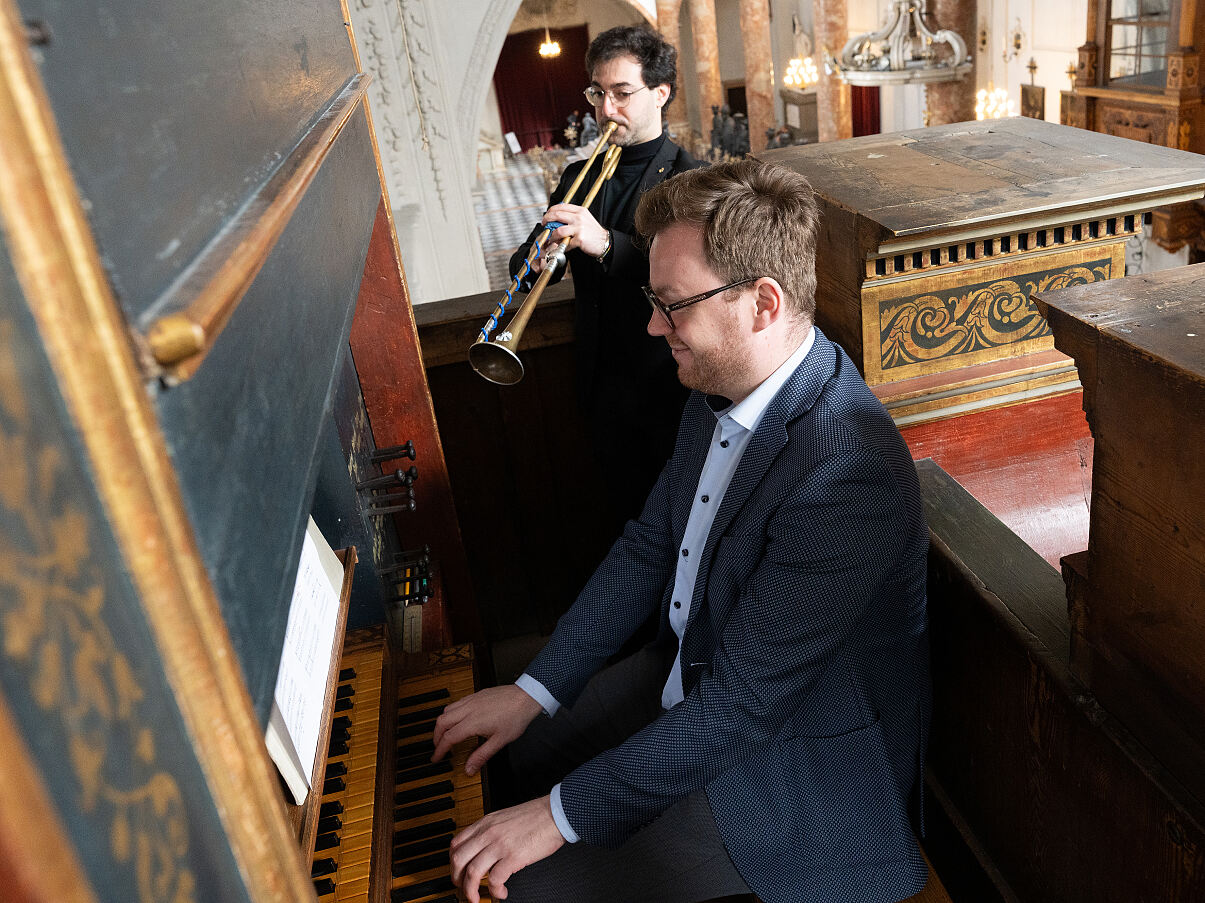
Marian Polin plays the Ebert organ in Innsbruck's Court Church, Mauro Musarra accompanies him on his baroque trumpet.
The idea behind Innsbrucker Hofmusik
You are not only the artistic-musical director of Innsbruck Hofmusik, you are also its co-founder. What is special about these concerts?
What's special about them is everything! The idea came about like this: I was working as a Kirchmusiker at the Jesuitenkirche in Innsbruck
and I was already collaborating with Franz(ed. Gratl) and the music collection of the Tiroler Landesmuseen.
We wanted to do a concert season with old repertoire between the Jesuitenkirche and the Hofkirche. That was almost 10 years ago: I moved to Innsbruck in 2016, and when they asked me what I wanted to do, if I could, I said: revitalize the Hofkapelle-the court chapel. We had the Hofkirche, which is part of the Tiroler Landesmuseen: a fantastic place, completely original, including the three organs; and we knew what they played in the Hofkapelle, because it's all preserved in inventories in Vienna and other archives.
Now Innsbrucker Hofmusik is a reality and is in its fourth edition. What is your repertoire?
We can say that we are the only festival in the world dedicated to the music of the Habsburg court from 1550 until 1730. We play not only the music that was actually played in Innsbruck, but also other music of the Habsburg court.
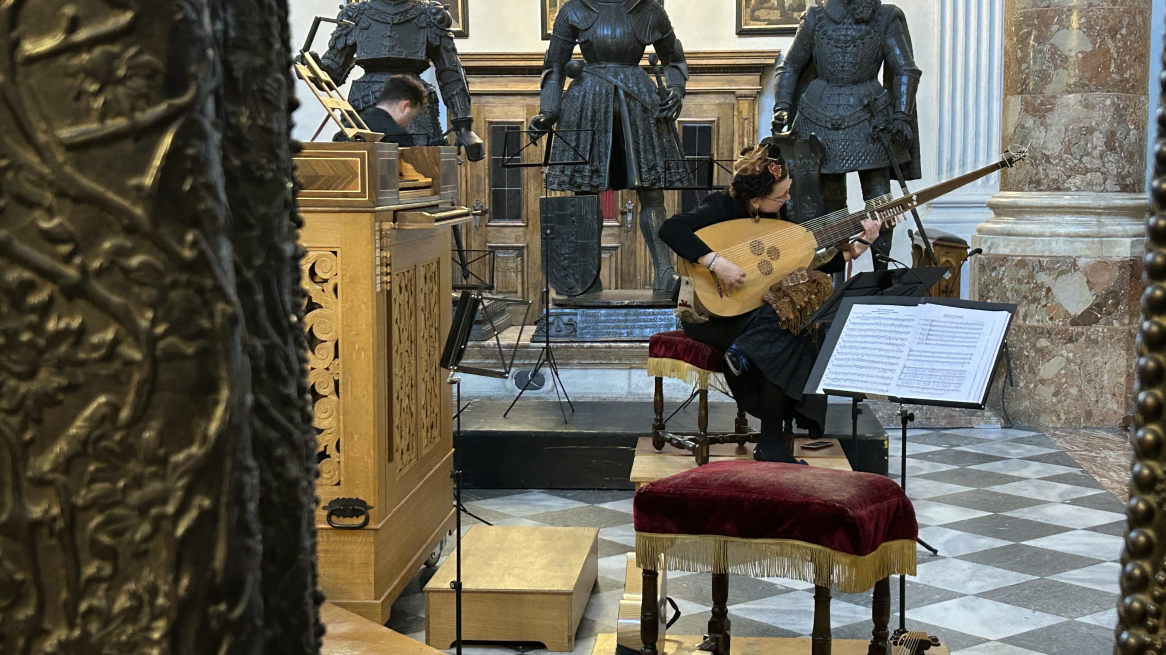
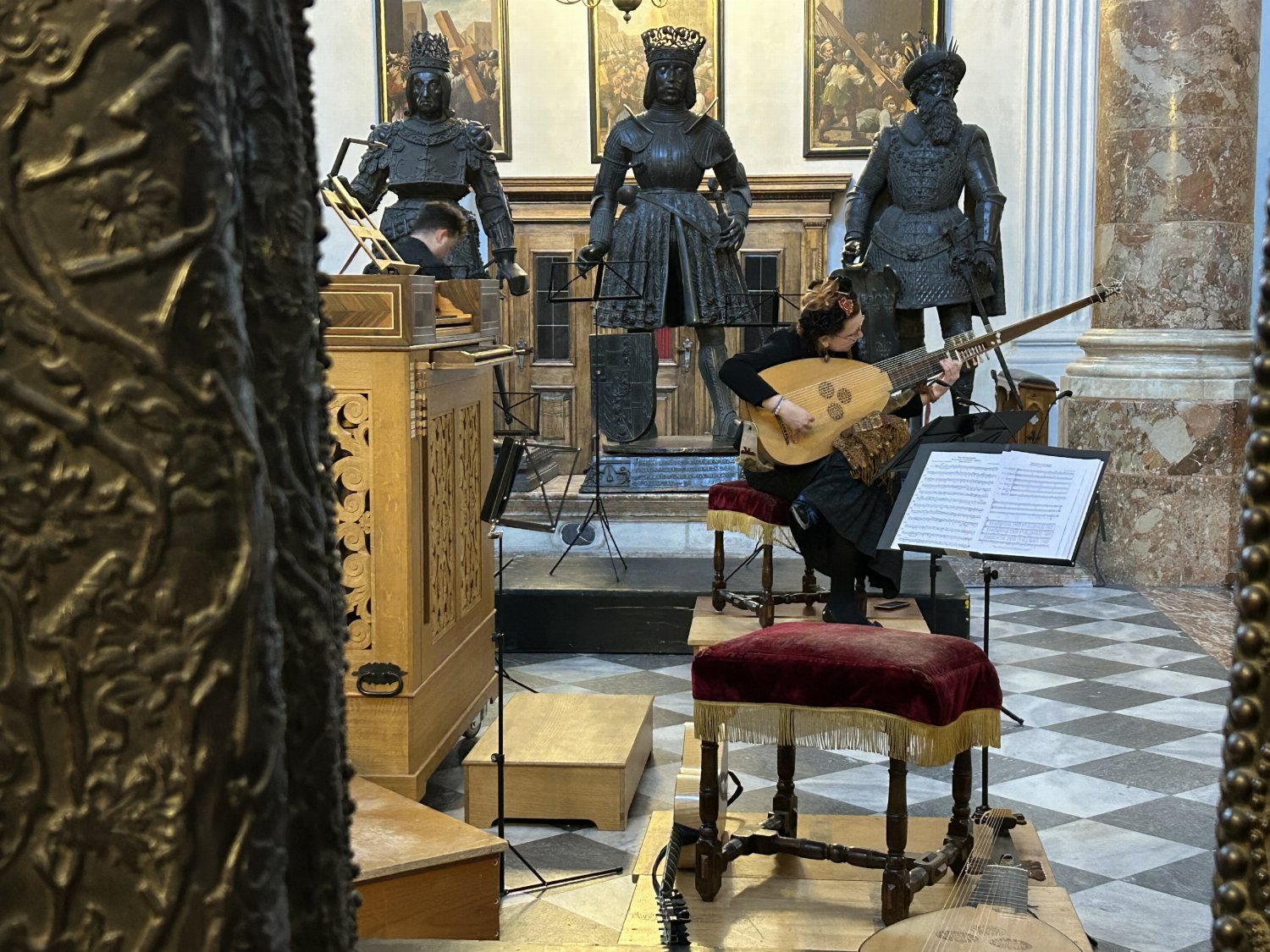
Innsbrucker Hofmusik musicians tune instruments before the concert in Innsbruck's atmospheric court church
THE REPERTOIRE AND ENSEMBLE
So your work is a philological work...
Yes, my and Franz's work, as director of the music collection of the Tiroler Landesmuseen, is to research the repertoire of that period in the Habsburg court, to find out who were the protagonists of the musical scene, who were the musicians... By now I know those personalities so well, that they are for me like colleagues, I feel like they are "living" people. I happen to feel this particularly with the personalities of the 1600s. With the 1500s I still struggle a bit, because it's more distant... (laughs).
The uniqueness of Innsbrucker Hofmusik is to put the music in its original context. Tomorrow we play Monteverdi's "Moral and Spiritual Forest," for example. Evidently we are not the only ones who have this music on the program. But what we do is to play this music in Austria and to connect it to the house of Austria; in fact Monteverdi dedicates this composition, which he wrote as an old man and which is considered his testament of sacred music, to Eleonora Gonzaga, Empress of the Holy Roman Empire and Archduchess of Austria.
The musicians and singers of the Innsbrucker Hofmusik ensemble are all quite young, like you! Sometimes you get a different idea of those who go into early music professionally...
We who do early music are the coolest! And the early music scene is very vibrant, in spite of what you might think.
The musicians and singers in the ensemble come from different centers of higher music education, such as Basel, Amsterdam, Milan. For the choice of singers I lean mostly toward Italy, because in my opinion it is currently the best school of Baroque and Renaissance singing there is. Whereas the instrumentalists are mainly from Tyrol, Austria, Bohemia, and Switzerland.

THE INNSBRUCKER HOFMUSIK SEASON 2026
Tomorrow you have the first concert of the 2026 season: would you like to tell us something about this year's program?
There are 6 concerts and they revolve around the princesses of the house of Austria. Tomorrow (April 24) we have Monteverdi's "La selva morale e spirituale," dedicated to Empress Eleonora Gonzaga. In May, to mark the 400th anniversary of Giovanni Legrenzi's birth, we present his oratorio, "La morte del cor penitente," performed at the court of Emperor Leopold I in 1705. In June we have music for the wedding of Claudia De' Medici Archduchess of Tyrol to Leopold V. In September we have Renaissance music with Jakob Regnart's "The Nymphs of the Inn," Sacred music for the Innsbruck court of Archduke Ferdinand II. In October sacred vocal works by various Italian composers from collections dedicated to women of the Tyrolean line of the Habsburg dynasty. And in November a program around Queen Christina of Sweden, produced in collaboration with Rome musicologist Luca della Libera. In Rome, Christina of Sweden was a famous patron of Corelli, of Carissimi, of a young Scarlatti, of Melani, and she publicly converted to Catholicism right here in Innsbruck, in November 1655, during her journey from Sweden to Rome.
Is there anything else you would like to tell our readers and our readers?
Yes, this beer is excellent!
Can I take a picture of you drinking your beer?
No, because it is finished! But if you offer me another one, though...
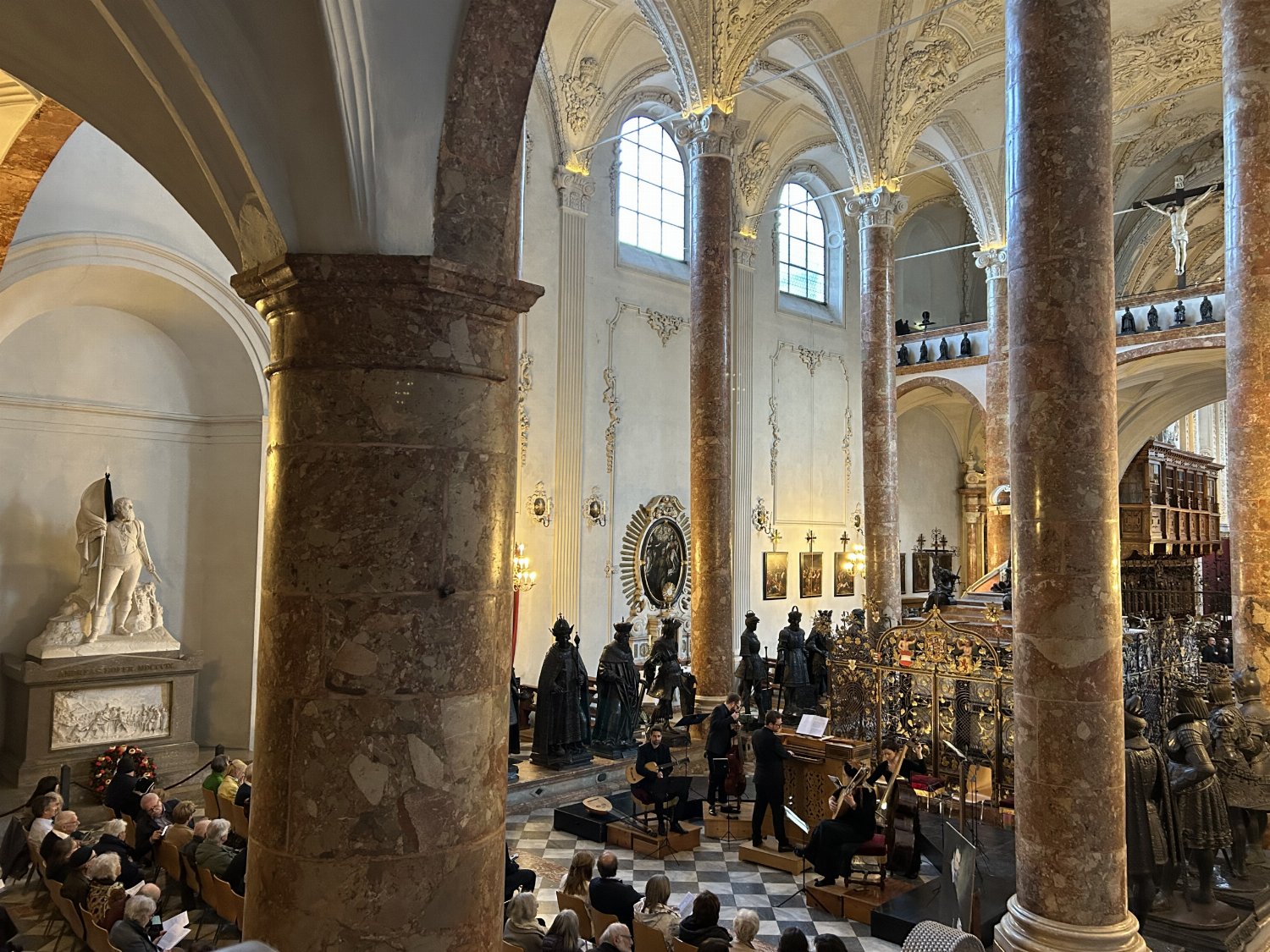
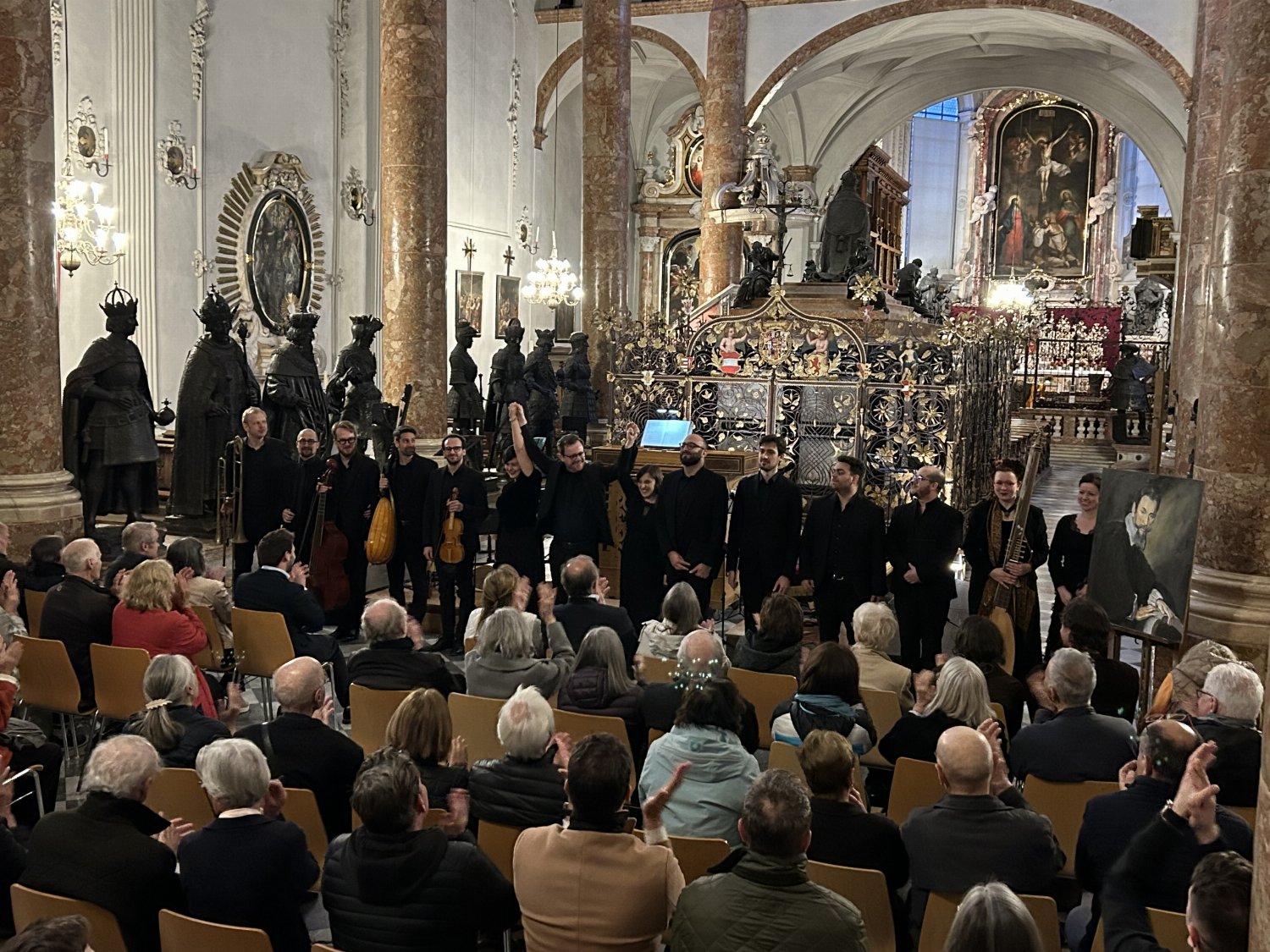
A roar of applause for the Innsbrucker Hofmusik ensemble at the end of their performance of Monteverdi's "Moral and Spiritual Forest" in Innsbruck's Hofkirche
THE INNSBRUCKER HOFMUSIK CONCERTS 2026
22.5.2026, 7 p.m
THE DEATH OF THE PENITENT COR
Hofkirche, Universitätsstraße 2, 6020 Innsbruck
26.6.2026, 7 p.m
FÜRSTLICHE HOCHZEIT 1626: LEOPOLD UND CLAUDIA
Hofkirche, Universitätsstraße 2, 6020 Innsbruck
25.9.2026, 7 p.m
DIE NYMPHEN DES INNS
Hofkirche, Universitätsstraße 2, 6020 Innsbruck
30.10.2026, 7 p.m
HARMONIA SACRA
Hofkirche, Universitätsstraße 2, 6020 Innsbruck
13.11.2026, 7 p.m
Kaiser-Leopold Saal, Karl-Rahner-Platz 3, 6020 Innsbruck
DIE PALLAS DES NORDENS
USEFUL INFORMATION
TICKETS
Full 35 euros, reduced 25 euros (Over 60s, Club-TT members, Club-Ö1 members, Verein Tiroler Landesmuseum Ferdinandeum members, Verein der Freunde des Tiroler Volkskunstmuseums members), students 10 euros (for students up to 27 years).
Season tickets for the 6 concerts: full 268 euros, reduced 120 euros
TICKET SALE
At the Tiroler Volkskunstmusuem box office or online.
PRE-CONCERT
An introduction and short pre-concert are offered free of charge at 6 p.m. before each concert.
Show me the location on the map
A visual artist from Milan who not only works with brushes and canvases but also loves writing about art, culture, music, design and creativity.
Similar articles
A Summer Weekend by the River Finally the summer weather we had been waiting for…
A Special Event Every year, the International Film Festival Innsbruck (IFFI) brings international…
First Signs of Summer Last week Innsbruck felt a little different. The Marktplatz…
Since 2013 presents Innsbruck International Biennial of the Arts has been presenting concise…