Famous for the Battle of Bergisel featuring " Andreas Hofer," but a place of cultural significance for thousands of years. The history of this hill in Innsbruck is worth a closer look.
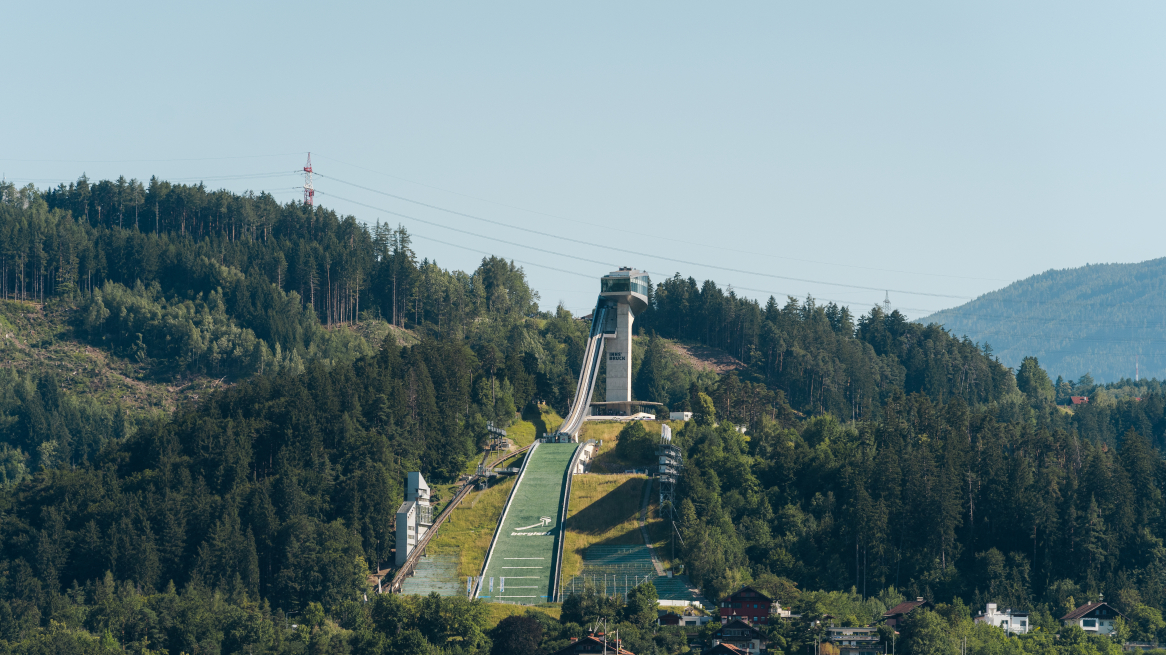
The 746-meter-high Bergisel in southern Innsbruck has a truly astonishing history stretching back thousands of years. The oldest traces date back to the Late Neolithic period, around 6,000 years ago. Artifacts from the Bronze, Hallstatt, and Iron Ages attest to the hill’s enduring popularity in prehistoric times—now forested—as a settlement and place of worship.
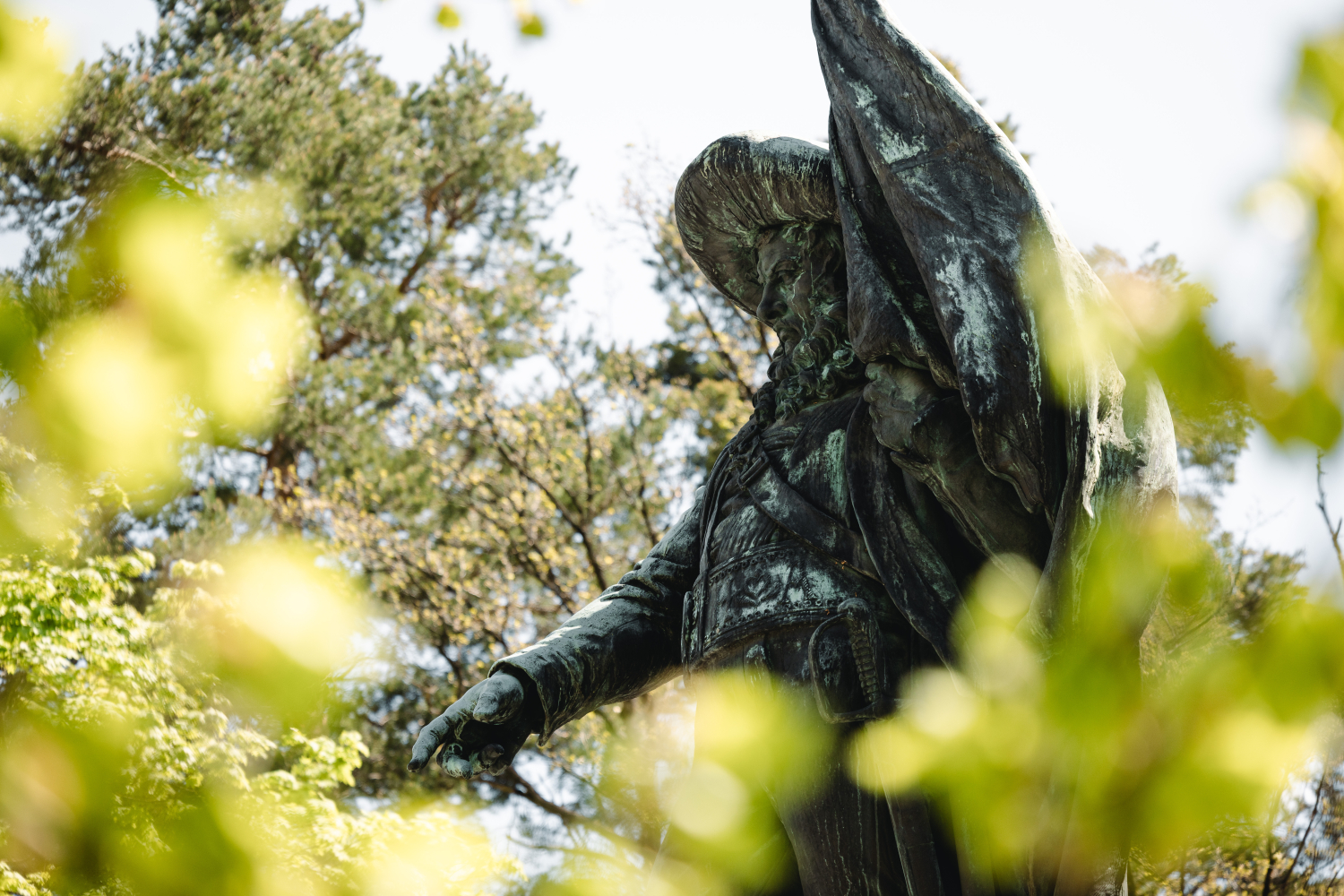
However, the Bergisel only became famous through the four battles fought by the Tyroleans against Napoleon’s troops in 1809. It was these bloody battles that catapulted the site—and above all, the leader of the Tyrolean riflemen, Andreas Hofer —into the state’s “eternal” hall of fame. In modern times, this fame has been supplanted and surpassed by “flying heroes”—the ski jumpers—who, with true disregard for their lives, launch themselves on two skis from the Bergisel ski jump down the steep slope toward the valley, always keeping the Wilten Cemetery firmly in their sights. Curiously enough, you can’t help but see it from the jump table and during the jump itself.

First Prehistoric Finds in the 19th Century
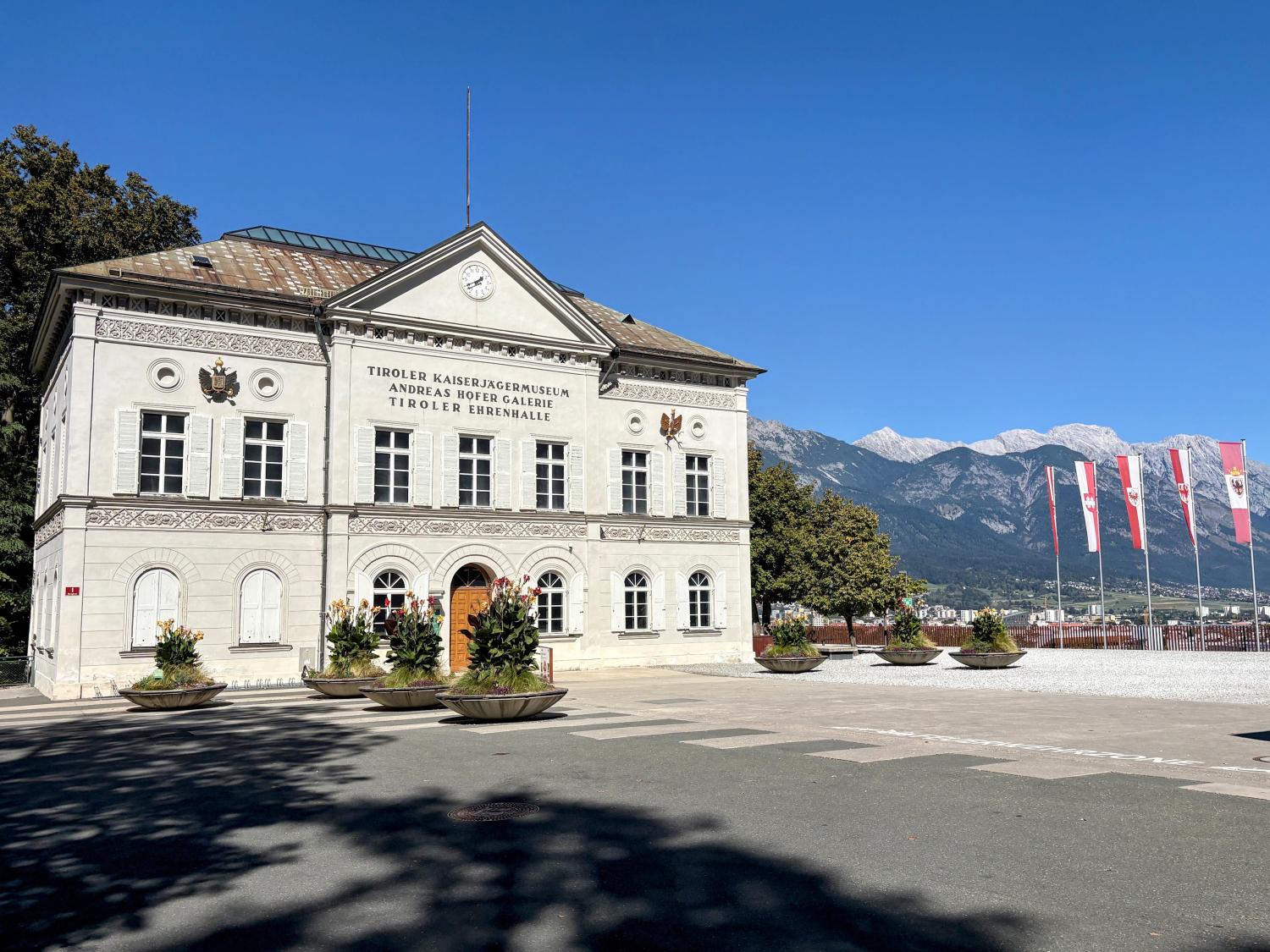
The first Bronze and Iron Age finds from the Bergisel were made as early as the 19th century. The Tyrolean State Museum Ferdinandeum still houses some remnants of a “treasure trove” that was allegedly “hauled away by the wagonload and sold by the centner to bell founders.” It is believed that the discovery was made during the construction of a predecessor building to today’s Kaiserjäger Museum—specifically, an officers’ mess hall.
People from the Stone Age once sat here, on the square in front of the Kaiserjäger Museum. Photo: W. Kräutler
The construction of the first concrete ski jump on Mount Isel in the early 1960s likely destroyed an Iron Age sacrificial site. The hilltop where the ski jump tower was to be built was simply “leveled,” even though ceramic fragments had been unearthed. At that time, however, awareness of prehistoric finds was not as widespread as it is today. It is unknown where the ceramic artifacts ended up.
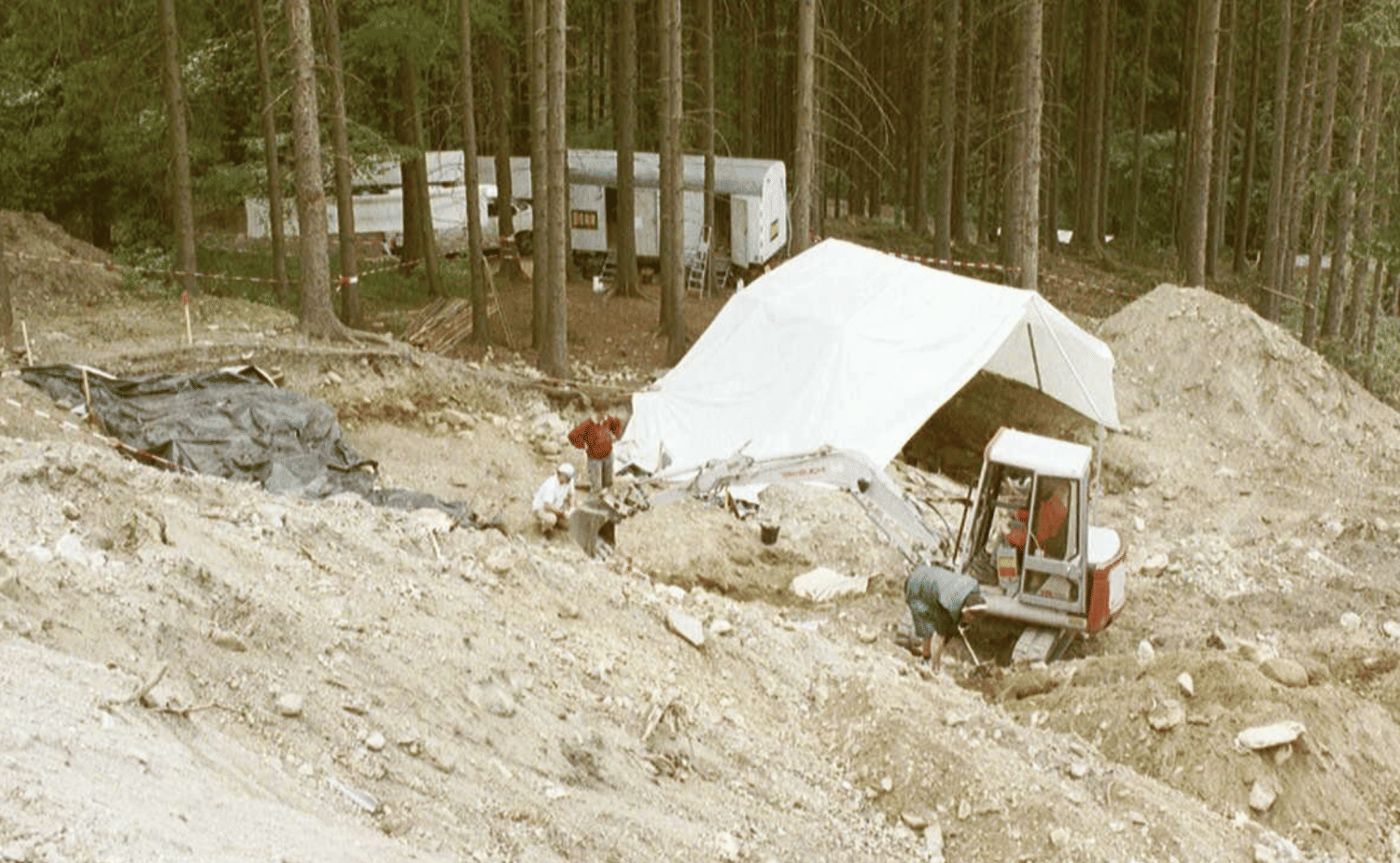
The 2001 excavations at the summit of Mount Isel yielded several findings: on the one hand, man-made terraced structures; on the other, evidence of several houses. ©Innsbruck City Archives
Archaeological Light Sheds Light on the Past
However, when plans were made in 2001 to build the new ski jump—and with it, another Innsbruck landmark—an emergency excavation became unavoidable. On the summit of the Bergisel, remains of a ritual burning site were discovered, while on the flat area in front of the Isel Museum, an Iron Age terraced settlement with building remains, as well as small finds made of pottery and bronze—and even two Celtic gold coins—were unearthed.
Sacrificial fires blazed on Mount Isel
It is a well-established fact that sacrificial fires were once lit on the summit of Mount Isel, the intense heat of which was even capable of “melting” stones. This is, incidentally, very similar to what occurred at theGoldbichl above Igls, which was presumably one of the largest sacrificial sites in the Alpine region. You can read the report by the excavation director at Berg Isel, Univ. Prof. Gerhard Tomedi, here: https://www.uibk.ac.at/de/archaeologien/institut/team/emeritiim-ruhestand/tomedi-gerhard/bergisel/
First Evidence: Houses Stood in the Innsbruck City Area as Early as the Stone Age
The next excavation took place in 2007, prior to the construction of the “Tirol-Panorama,” under the direction of Johannes Pöll from the Federal Monuments Office. The excavation site focused on the northern area of the planned “Tirol-Panorama.” The results of the excavation were nothing short of sensational. They provided evidence that this hill had been inhabited from the Neolithic period—specifically the Early Neolithic (4400–2200 BCE)—through the Bronze Age and into the Latène —and Iron Age. It was not until the Romans arrived that they settled on the plain near Wilten and abandoned the “high ground” on the Isel.
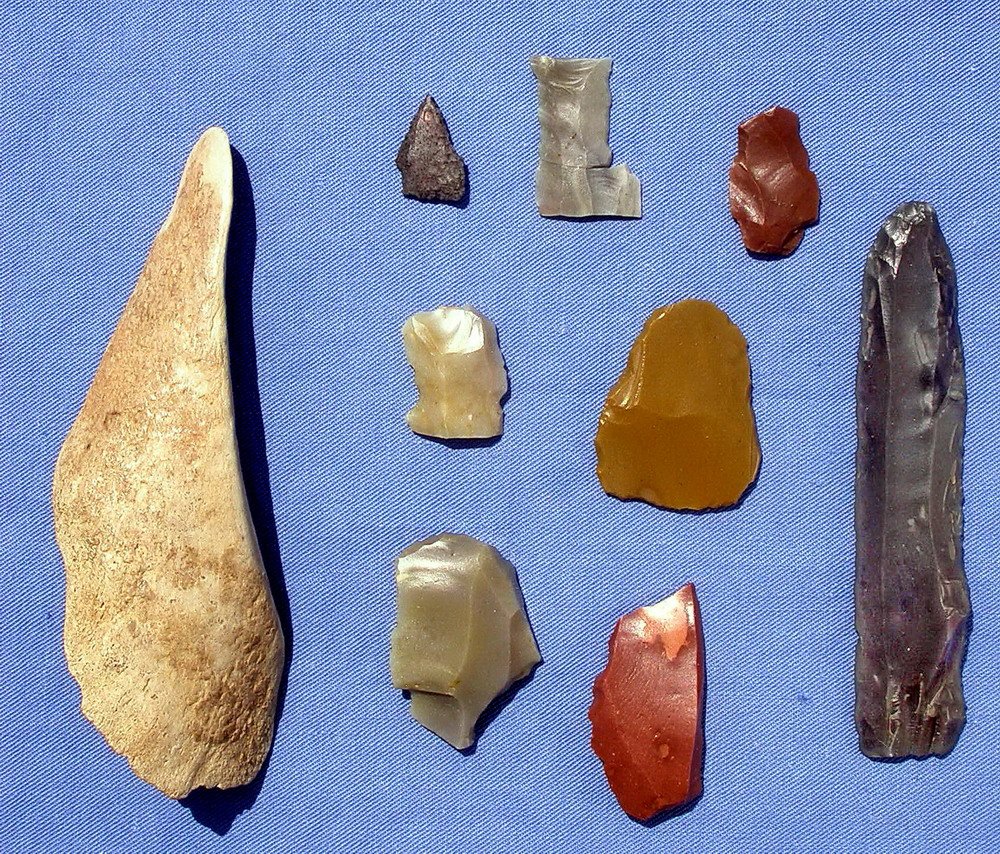
A beautifully crafted stone knife, which helped date the find, was the real highlight of the collection. Eight stone artifacts from the Neolithic period and polished animal bones also prove that people were already inhabiting the Bergisel as early as the Neolithic period—that is, around 5,500 years ago. They were discovered near six so-called “post holes,” which, based on the excavations, suggest the construction of a house. This was the undisputed “highlight” of the excavation. After all, Neolithic finds in Innsbruck had been more than modest up to that point. While “scattered finds” are known, they had not previously been attributed to any settlement.
Artifacts from the Stone Age found on Mount Isel. On the left is a polished animal bone; in the center are flint blades; and on the right is a beautifully crafted stone knife. ©Burkhard Weishäupl, Federal Monuments Office
“The finds are significant for Innsbruck because they provide evidence that Innsbruck’s Bergisel was already valued by Stone Age people thousands of years ago,” writes Burkhard Weishäupl in an excavation report by the Federal Monuments Office. The fact that Neolithic finds in North Tyrol are exceptionally scarce makes the findings and the flint artifacts from the Bergisel even more valuable.
In the Stone Age, they built with wood
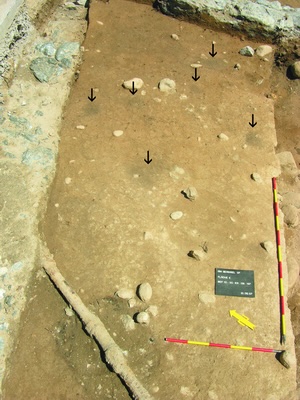
For researchers, however, the six unremarkable post holes are of great interest. They prove that simple wooden structures actually stood here during the Neolithic period (5,500 to 2,200 BCE)—until now, there had been hardly any evidence of such settlement in North Tyrol. Johannes Pöll even suspects the presence of an entire Late Neolithic settlement site in the area that has not yet been excavated.
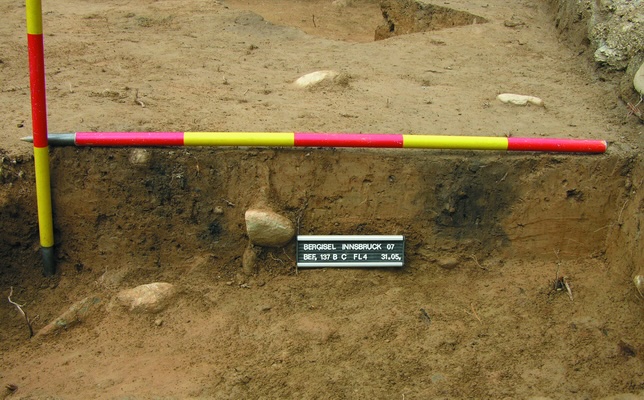
This is how archaeologists identify post holes: they are dark and stand out from their surroundings. Photo: Burkhard Weishäupl. Federal Monuments Office
Thousands of years ago, a Stone Age dwelling made of wood stood here. Photo: Burkhard Weishäupl, Federal Monuments Office
Flint Imports from the Southern Alps
It is also interesting to note where the “Innsbruck Stone Age people” obtained their raw material for flint tools. Most of it came from the area of the Monte Baldo or Monte Lessini, located 150 to 200 kilometers away. This, in turn, proves that after the Ice Age, people crossed vast distances and even high mountains. It also demonstrates that long-distance trade began to flourish.
Knowledge Transfer in the Stone Age
It is also somewhat surprising that trade apparently led to intensive cultural exchange among people across great distances. Archaeologists draw this conclusion from the shape and manner of working of the flint and animal bones that have been found. Take, for example, a pointed flint blade: A pointed blade found on the Rhine island of Werd near Stein on the Rhine in Switzerland shows a strong resemblance to the blade from Bergisel. Such “Berg Isel”-style flint blades were not produced exclusively there. Perhaps the best parallels can be seen in a blade found on Lake Zug in Switzerland, which has been dated to the Late Neolithic period. These facts suggest a lively prehistoric “transfer of know-how.”
5 kilograms of lead bullets as an archaeological “find”
The fact that the mountain eventually became known as the Tyrolean “Heroes’ Mountain” can be attributed to the four battles fought there, in which Tyrolean riflemen prevailed three times against Bavarian and French troops but lost the fourth time. Just how fierce the fighting must have been back then is illustrated by a “find” from the 2007 excavation. At that time, a total of five kilograms of lead bullets were unearthed—evidence of just how intense the gunfights were.
The Modern Bergisel: A Playground for Ski Heroes
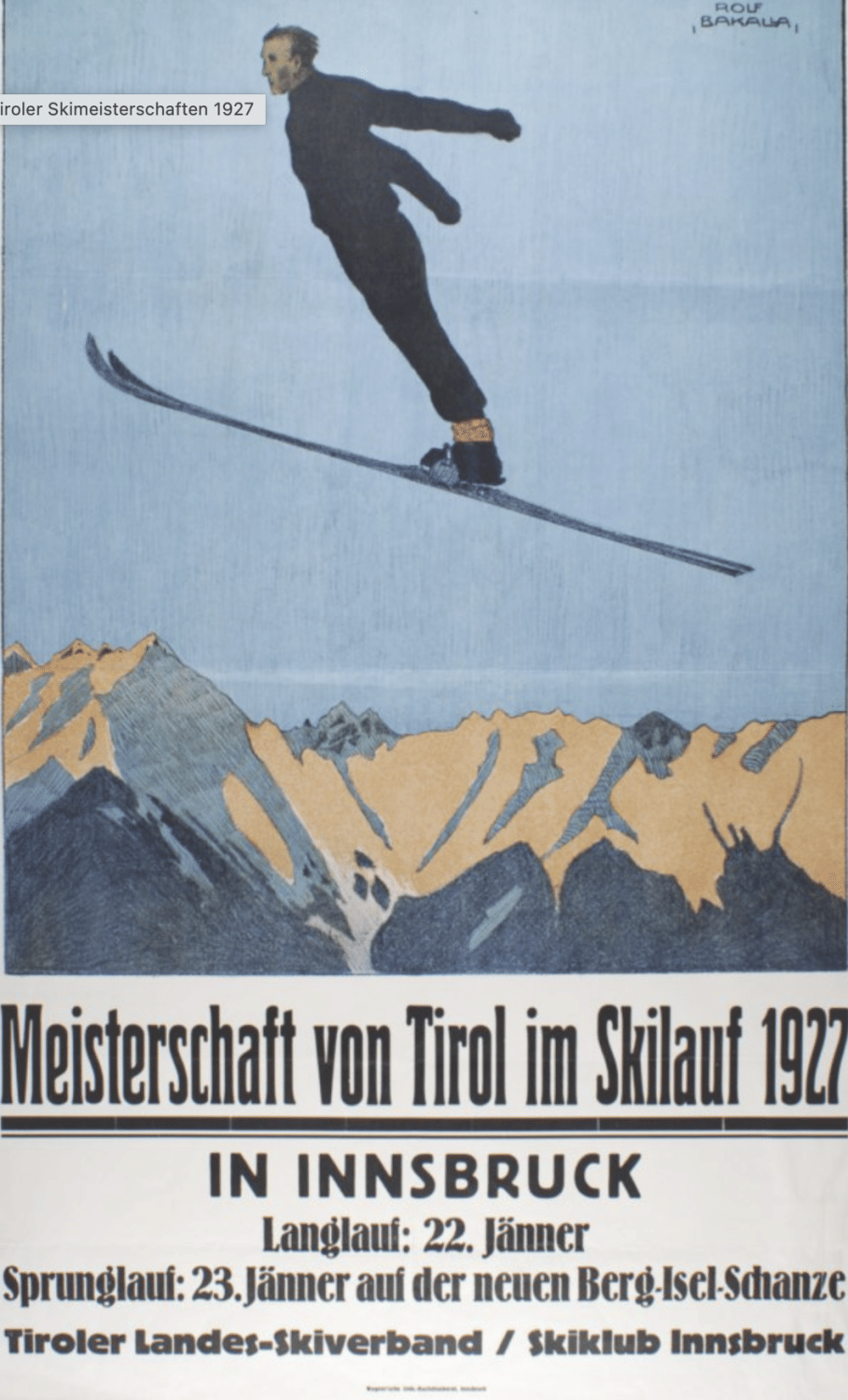
Starting in 1927, sporting competitions replaced the military conflicts. The first ski jumping event at the Bergisel took place on January 23, 1927, as part of the Tyrolean Ski Championships. It was still held on a natural hill without a jump tower.
Ski jumping on the Bergisel hill as part of the German-Austrian Four Hills Tournament is now one of the world’s most popular ski jumping events. Its winners are the new heroes who take to the Bergisel year after year.
Starting in January 2027, the Bergisel Ski Jumping event as part of the Four Hills Tournament will also feature a women’s competition. The former cult venue—and today’s pilgrimage site for sports fans—will now also serve as the stage for top performances by female sports heroes.
Show me the location on the map
A volunteer at the "Schule der Alm" alpine farming school, cultural pilgrim, Tyrol aficionado and Innsbruck fan.
Similar articles
Anyone who attended the 2019 premiere of the play “Verkaufte Heimat” at the Tiroler Volksschauspiele will feel…
A very special kind of museum recently opened its doors in Zirl. It showcases the driving…
Spring brings a craving for things to do and be out and about--why not take a tour…
The name of this landscape alone exudes a mysterious magic: St. Moritzen. Located to the west…