While the 25th Winter Olympics will open in Milan in February 2026 and Cortina d'Ampezzo in Italy, Innsbruck is celebrating 50 years of the Olympics and commemorating the 1976 Games. To mark this special occasion, a legend is returning to his mountain of destiny: Franz Klammer is visiting the Patscherkofel, where he became a downhill winner and thus immortal with a legendary heroic ride.
Olympic city
"Innsbruck is primarily known as a sports city," is how I start (almost) every one of my guided tours as an Austriaguide. Innsbruck owes this reputation primarily to the 1964 and 1976 Winter Olympics. A third Olympic flame at the Youth Olympic Games (YOG) in 2012 rekindled this reputation, as do other major events in a wide range of disciplines and the annual Bergisel ski jumping competition as part of the Four Hills Tournament.
Sport as identity
Even apart from these professional events, Innsbruck is the epitome of sportiness - in everyday life: Anyone who goes hiking here or in the surrounding area will see someone jogging or cycling past at a crazy pace, carrying a mountain bike up the mountain and then riding down on it, or someone who has already completed a climbing tour and still makes a detour to a hut. People joke about people who cycle through the city in ski boots and with skis strapped to their rucksacks ... Well, in Innsbruck these images are part of everyday life from November to April.
One step back and Olympia everywhere
The fact that two Winter Olympics were held in the same city within just 15 years naturally has a history: Denver was originally awarded the 1976 Games, but after a referendum in Colorado, this mandate was returned to the IOC in 1972. In a second round, Innsbruck was chosen.
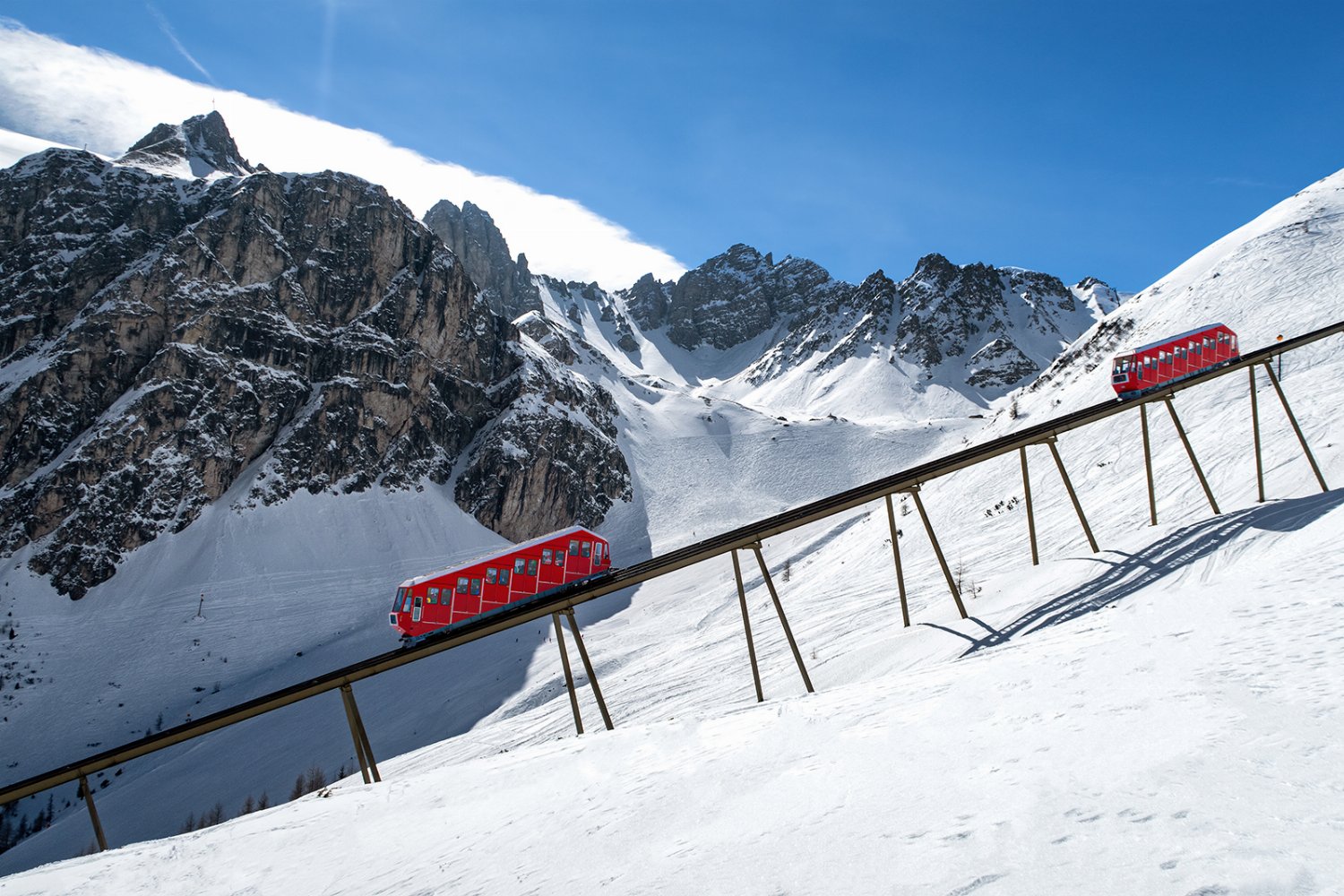
The traces of the 1964 and 1976 Games and, not least, the 2012 Youth Olympic Games are still clearly visible in the city today: from the huge Olympic rings at the Olympic Hall to three Olympic Villages and a district named after them, various infrastructures such as the Olympic funicular in the Axamer Lizum and countless streets or hotels with "Olympia" in their names, these memorials are virtually omnipresent here.
The Olympiabahn in the Axamer Lizum was built between 1973 and 1975. (Photo: © Danijel Jovanovic Photography)
Unforgettable atmospheres
Firstly, I personally lack any sporting ambition and secondly any enthusiasm for passive sport on television. However, I find it absolutely thrilling to be there live at a sporting event. Whether it's an ice hockey match, soccer match, ski jumping competition, pole vault or long jump (keyword: Golden Roof Challenge), Climbing World Cup or Beat the City (keyword: Innsbruckathlon) - all these events have always impressed and thrilled me in equal measure. And one thing has to be said: if Innsbruck can do anything, it's sporting events!
Live is Life
Nevertheless, I have never experienced the Olympic Games live and it is difficult for me to imagine the atmosphere back then. But if you talk to my parents' generation, who were around 15 years old in 1976, you quickly realize that "excitement" would almost be an understatement. Everyone remembers exactly where they saw this or that race live or on television. The emotions are still palpable 50 years later, just like historical moments that are etched in our minds - comparable to the moon landing, the fall of the Berlin Wall or September 11th.
This capacity for enthusiasm and this power to unite people and entire nations peacefully are extraordinary and important strengths of sport. Moreover, this is also the basic idea behind the Olympic Games (as I understand it), which we should remember today more than ever.
Franz Klammer and the Patscherkofel
The 1976 Olympic hero, Franz Klammer from Carinthia, is completing an intensive program in Tyrol to mark the 50th anniversary of the Olympic downhill race on 5 February 1976. He returns to the Patscherkofel for a legendary race with many old ski stars and meets, among others, the then runner-up Bernhard Russi (Switzerland). He goes from photo session to podcast interview and finally to the "Talk about Tirol" at the Landhaus in Innsbruck. I'm also there and eager to hear anecdotes about this Olympic success.
When I arrive at the Landhaus, the foyer is already full. It quickly becomes clear that the majority of the guests still remember the 1976 Games and were "there" in some way. The Great Hall, including the gallery, is filled to capacity.
Talks about Tyrol
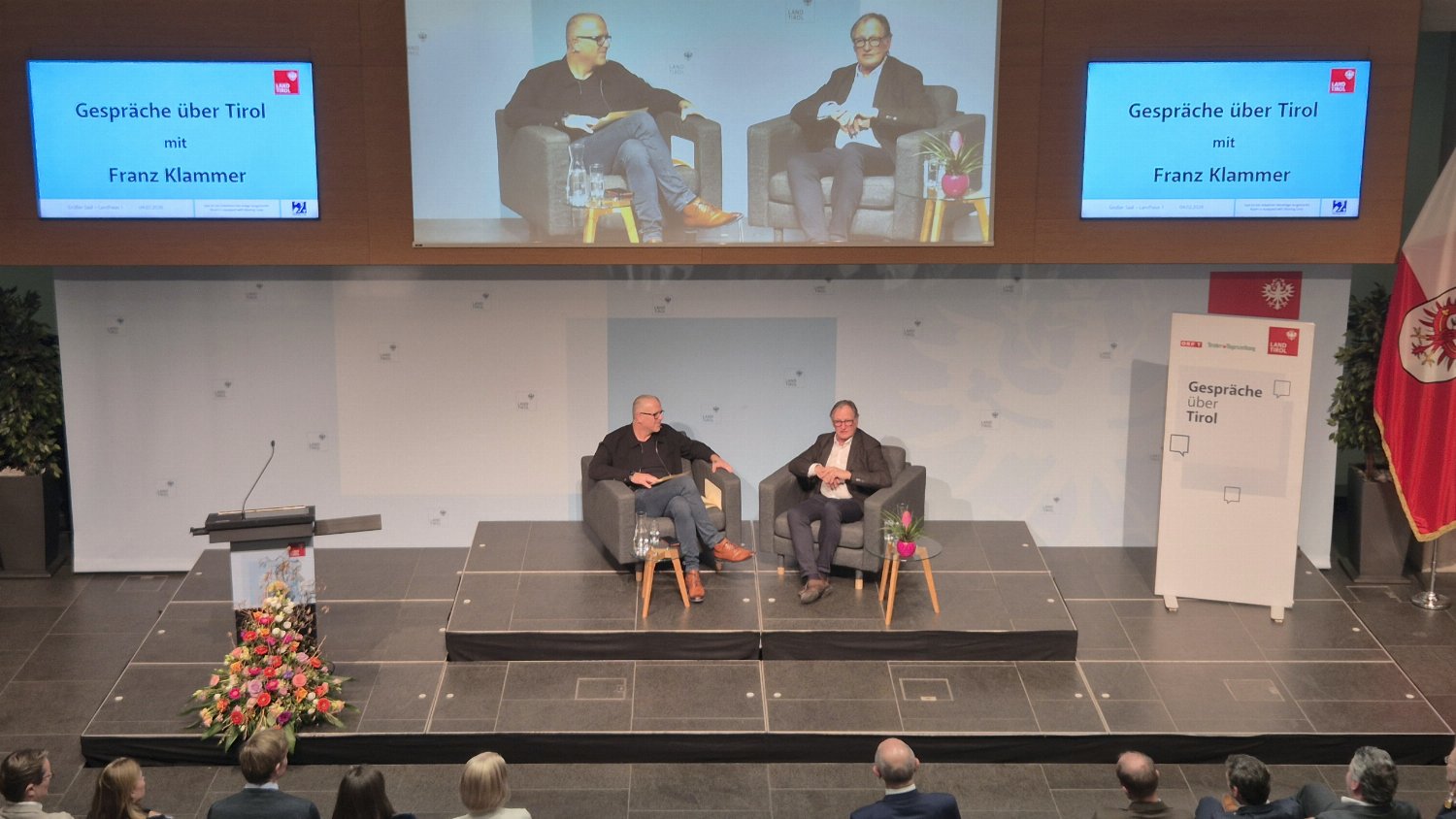
The "Talks about Tyrol" series is organized by the state of Tyrol with the support of Tiroler Tageszeitung and ORF Tirol and is moderated by the well-known crime writer Bernhard Aichner. Before things get underway, the importance of the 1976 Winter Olympics as a major media event will be highlighted.
TT editor-in-chief Marco Witting has dug out a copy of the special edition from February 5, 1976 from the lock-up archive to present to Franz Klammer in person. For the first time that evening, the Olympic champion seems somewhat moved. The printing presses for this edition were fired up just 17 minutes (!) after Klammer's victory so that the freshly printed newspapers could be distributed to the 60,000 fans streaming into the city from the Patscherkofel.
Georg Laich from ORF Tirol describes the Olympic downhill as TV history, as it was one of the first major events to reach the masses on color television in their living rooms. The images of Klammer in his yellow racing suit and red-white-red helmet are just as legendary as the presentation by commentator Edi Finger.
A provincial governor in a joyful frenzy of remembrance
In his welcome address,Governor Anton Mattle tells an authentic, enthusiastic and emotional story of how he and his uncle experienced the Olympic downhill on the Patscherkofel as 13-year-olds. The story is full of suspense, as Mattle lost his uncle in the hustle and bustle, had gendarmes take him to the train station and was lucky enough to find him again. The politician describes the scenes as if they had only taken place yesterday.
Top! The bet is on!
He also tells two anecdotes that unexpectedly show me what sporting triumphs can trigger: (1) The then Austrian sports minister Fred Sinowatz had announced before the Olympics that if Klammer won, he would walk up the Patscherkofel. And the rather unathletic, overweight sports minister fulfilled this promise and climbed Innsbruck's local mountain. (2) The sacristan of the Paznaun community Mathon, who was both a skiing enthusiast and a believer, had a different idea: he wanted to ring all the bells at midnight if Klammer won. - And so it happened.
I am pleasantly surprised by this amusing start to the evening and very excited about the upcoming interview with Franz Klammer.
Olympic Games
When Klammer comes on stage, I wonder how often he has had to answer (presumably always the same) questions about the Olympic downhill in the past 50 years. Today again. The questioner Bernhard Aichner has prepared himself extremely well and has probably read every available interview with Klammer and watched the movie "Klammer - Chasing the Line" again. His questions are written on countless sheets of paper, which he works through and files away one by one.
So far, I've only "known" Klammer from television, and I've always perceived him as likeable, funny, down-to-earth and relaxed. And that's exactly how he presents himself this evening. Patient, authentic and with a wonderfully dry sense of humor, he answers all questions.
Plan A: Skiing - and no plan B
It is said that Franz Klammer was already on skis at the age of two, but he can't remember that himself. In any case, he always enjoyed it and it was what he wanted to do, Plan A so to speak. There was never a Plan B, Klammer admits, and it is lucky that Plan A worked out so well.
Klammer's early skiing memories are associated with strenuous ascents on foot; he only took his first lift rides at the age of eight. He then skied his first races as a 14-year-old and later became the most successful racer in this discipline in World Cup history with 25 downhill victories and winning the Downhill World Cup five times. His other successes included: four Streif victories in Kitzbühel, World Championship gold in the combined and World Championship silver in the downhill (both St. Moritz 1974), World Championship gold in the downhill and Olympic gold in the downhill (both Innsbruck 1976).
Impressive logic
Klammer raced in all competitions, but the downhill became his favorite discipline. He explains why with a wink: "Downhill skiing is freedom! And it's the easiest, you start at the top and just let it go. Plus, there aren't so many gates in the way and you don't have to get up so early because the races don't usually start until midday."
The wilder and more difficult the downhill runs were, the greater the attraction for Klammer. The Streif (famous downhill slope in Kitzbühel) is the most beautiful of all for him because it remains the "absolutely wildest" downhill run. He has won there four times, once with a training injury to his leg and a lead of just one hundredth of a second.
The bracket style
Klammer had his own style of skiing, with his arms typically rowing in the air. Aichner asks whether he "invented" carving? Klammer spills the beans and amusedly recounts confusing instructions to the contrary from his coaches. But he has found his own style. "Carving? Well, it may be that I set the edges differently in the snow than the others. My advantage was certainly that it took the others at least two years to figure out what Klammer was actually doing." Klammer's wit is unique and the Innsbruck audience, myself included, is hanging on his every word.
Olympic thriller in Innsbruck
The pressure before the home games in Innsbruck was immeasurable. Not only from outside, Klammer also built up pressure himself. He wanted to win, completed seven training runs, each of which felt even slower. The demand from Fischer (= ski manufacturer) to use the new hole ski in the race became an additional challenge. This exciting story can be seen in the movie "Klammer - Chasing the Line".
Klammer decides against the tested hole ski and in favor of his tried and tested C4 ski, with which he has won virtually everything. He also opts for his yellow racing suit and against the gold-colored Olympic outfit of the Austrians. And so he skis to victory. But until then, he has to endure what is probably the longest wait of all: He only starts the race at number 15.
A stone fell from his heart at the finish line. "Or rather a lot of stones. The pressure of two years has fallen off me."
Doping control - Beer - Press conference
Aichner asks a juicy question: "Is it true that you needed five beers to be able to pee?" I don't know the answer at first, but Klammer explains: "After the race, you have to go to doping control. And I couldn't pee. The team doctor gave me a beer, but I couldn't pee after the first one. Then a second one and so on. At some point I had drunk six beers and was finally able to hand in my sample. I was late for the press conference."
Pleasant and essential
Aichner repeatedly asks what the sudden fame was like for Klammer or how he experienced meeting celebrities from all over the world in person? Klammer answers both questions similarly, saying that it was "pleasant", but that it was never about that. A pleasant side effect, so to speak. It sounds sincere, because it was only ever about one thing: skiing.
Risk and fate
Aichner asks how he feels today when he sees the safety measures of that time, manageable safety nets and relay fences. Klammer says nonchalantly: "It's quite simple: if you see the trees and the relay fences when you're racing, you're going too slowly. You just have to look at the track and then you'll be fast."
On a more serious note, he adds that he has never lost respect for the sport and has always been aware that you can 't be reckless. So true.
Franz's brother Klaus was seriously injured in a skiing accident and has been paraplegic ever since. Franz made a conscious decision to continue racing, while his brother proved that it was possible to cope with a devastating blow of fate. Franz Klammer later set up the Franz Klammer Foundation to provide financial support for athletes recovering from injuries.
The conversation continues about the time after the Olympics, the end of his career in 1985 and everything that followed. Klammer's wife Eva sits in the audience and together they talk about how happy they are with the film "Klammer - Chasing the Line" and how closely the whole story resonates with them. The film is shown that evening at the Metropol Cinema.
The entertaining evening passes quickly and when Aichner finishes the "Talk about Tyrol", the whole auditorium is clapping in a standing ovation within seconds. Now the "Skikaiser" is a little moved for a second time.
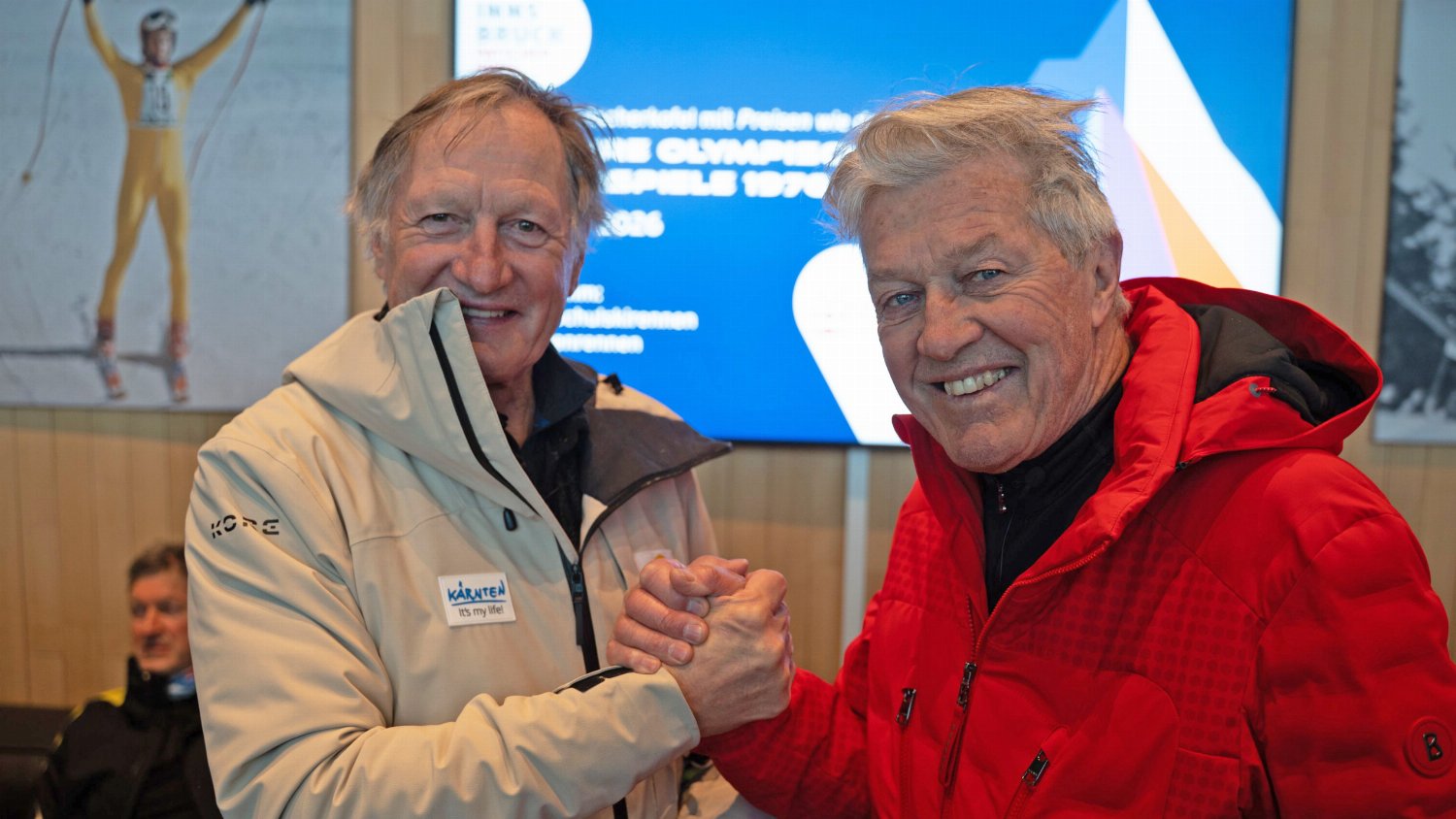
50 years later in Innsbruck: Franz Klammer and Bernhard Russi (Photo: © Alexander Rieck, FranzKlammerFoundation.com)
Capturing memories
As I close my notebook, the lady next to me speaks to me and asks for a piece of paper. She's been a fan since she was 14 and would love to get an autograph. By the time I get to the stage, Klammer has completed the press photos and is taking countless selfies with his fans. The queue is long and I hope that the lady will get her autograph. - But I'm actually quite sure of it, because in Innsbruck he is just as he always seems: down-to-earth and approachable. A legend.
Tips
Podcast: Innsbruck podcast on 50 years of the Olympics by Sandra Tilg and the Stubnhockers
Exhibitions:
Photo exhibition at Bozner Platz, February 2026
Buildings for Olympia, Archive for Building.Art.History, Level 6 in the Adambräu, until 22.02.2026
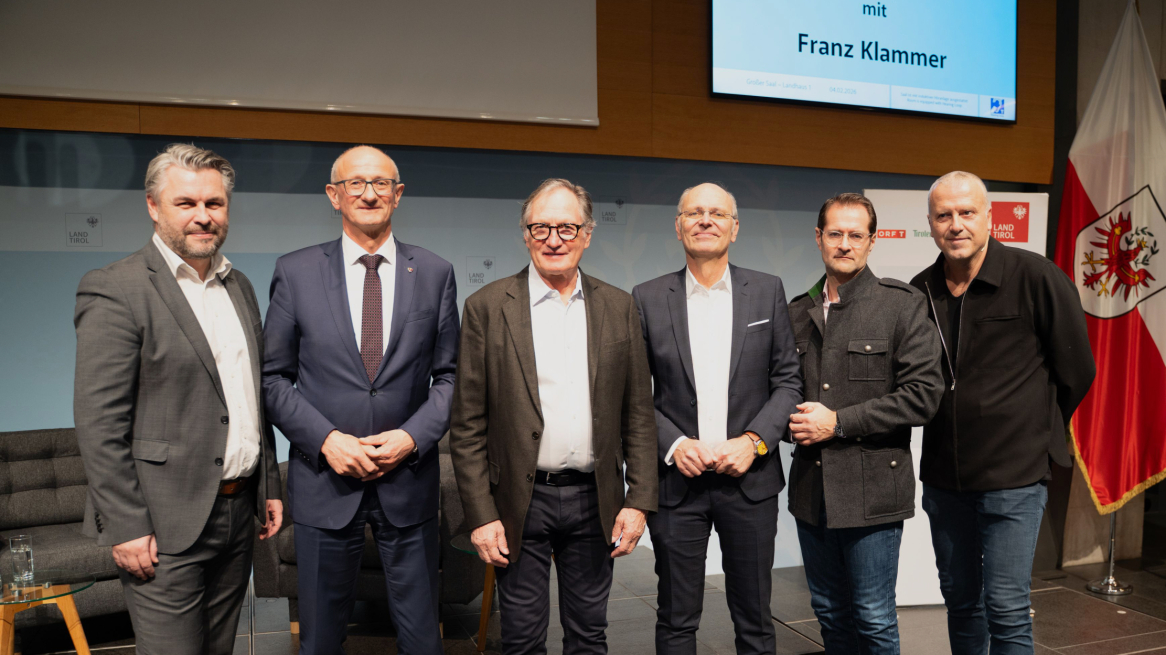
Cover picture at the top: from left to right: Marco Witting, Anton Mattle, Franz Klammer, Georg Laich, Christoph Schuh, Bernhard Aichner (© Alexander Rieck, FranzKlammerFoundation.com)
Show me the location on the map

A Tyrolean girl, graphic designer, blogger and tour guide with a variety of interests and a weakness for nice people, culture, starry night skies, one more beer and the mountains.
Similar articles
In this article, I’ll show you just how beautiful Innsbruck is in the early morning hours.
In mid-May, the time had come: they gathered (once again) for the 28th Alpine Region…
The gateway to Innsbruck's city center is open again: Anyone walking from the main train station towards…
Six years ago, a website went online that is now one of the absolute stars of…